
Tired is the enemy of speed - Are our kids skating too much?
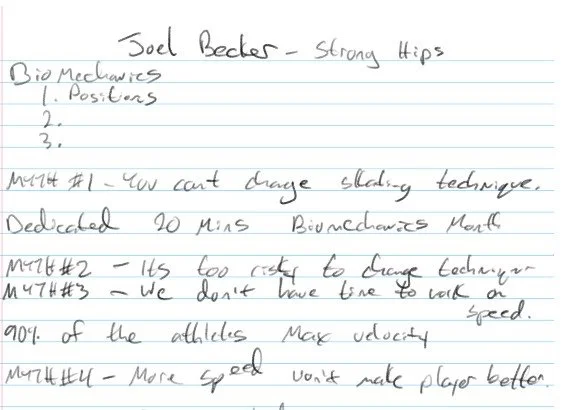
Handwritten notes from Joel Becker's Strong Hips talk at The Coaches Site Conference
Every parent I know wants the same thing: for their kid to love this game, stay healthy, and have the chance to play as long as they want. And yet, more and more, I'm watching families carry a quiet fear, the fear that if their child isn't on the ice constantly, they'll fall behind.
This week’s blog comes from the conversations I've had with families trying to make the best decisions they can, and also a personal place. I had hip surgery at 25. I'm 41 now, and if I don't pre‑hab and re‑hab my left hip, I'm in pain. I'm telling you that up front because my goal is to share information to parents and coaches to prevent overuse injuries.
And before I go any further — I know what some of you are thinking. "David, you run DS3. You put on skating sessions. You run camps. How are YOU telling us kids today are skating too much?"
That's a fair question, and it gets at exactly why I'm writing this. The goal at DS3 has never been more ice — it's been the right ice, at the right time, built into a year-round plan that develops the whole athlete.
🏒 Are Our Kids Skating Too Much?
This past summer at The Coaches Site Conference in Ann Arbor, MI, I attended a talk by Joel Becker called Strong Side, Strong Hips: The Biomechanics of Elite Skating, and it got my wheels turning about how often players at different ages should actually be on the ice because it does matter how old your player is and how many ice touches they are getting during these training months we are in right now.
Winter season ends, and before the Zamboni doors are even closed, families are signing up for spring hockey. Spring rolls into summer. Summer rolls into tryouts. Tryouts roll back into winter. Before you know it, we've got 10- to 12-year-olds playing 10 to 12 months of hockey a year.
I get it. I've been that parent. The pressure is real, the FOMO is real, and the fear of falling behind is real. But I want to share a few things I've learned and a few things the research is saying that have changed how I think about this.
🏒 Joel Becker's Talk and What Stuck With Me
Joel's presentation was all about strong hips and how hockey players generate speed. One of the biggest things I wrote down in my notebook was this: "Tired is the enemy of speed."
He talked about how speed work needs to happen at 90%+ of maximum velocity, with full recovery between bouts. In other words and like we have been talking about, quality over quantity. The research he shared was wild too. NHL Players who can hit one or more 22+ MPH bursts in a game score 12 goals per season on average. Players who stay under 20 MPH? 0.7 goals per season.
That's not a typo. That's the difference between a top-line player and a fourth-liner.
But here's the part that really got me. Speed isn't built by skating more. It's built by skating better, with fresh legs, and then getting off the ice and getting into the gym.
Piling on-ice volume is actually the opposite of what develops speed.
(Watch a short clip of the talk HERE)
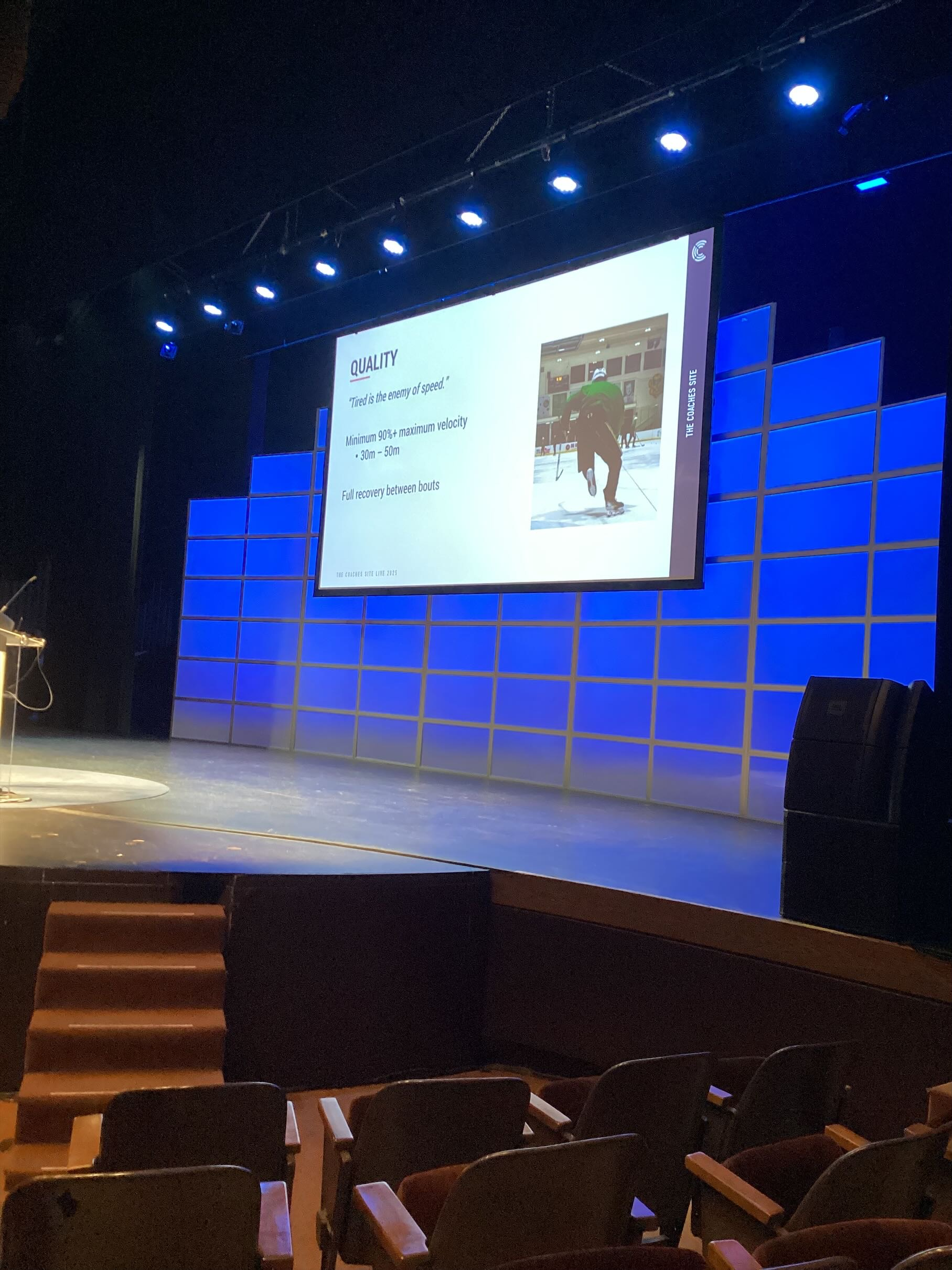
From Joel Becker's talk at The Coaches Site Conference, Ann Arbor 2025
🧊 What Happens When Kids Skate Too Much
I am not a doctor and I am not sitting around reading giant research papers. But after Joel's talk, I went digging into some studies because what he said lined up with something I've been thinking as I continue to grow as a coach….are our kids on the ice too much?
Here's what I found:
1. Skating reshapes young hips — literally. This one really blew my mind! - A prospective MRI study by Hanke and colleagues (2021) followed adolescent hockey players and found that a bone change called cam morphology develops in the femur (your thigh bone where it meets the hip) during the final growth spurt between ages 13 and 16. The repetitive shear forces from skating, over and over again, during the exact window when bones are growing fastest, actually changes the shape of the hip joint. (Short Clip HERE explaining the injury)
2. Hockey players have this more than other athletes. A study by Dr. Marc Philippon out of Vail (2013) looked at 61 youth hockey players and compared them to 27 youth skiers. 75% of the hockey players had the hip shape associated with impingement. The skiers? 42%. Hockey players were 4.5 times more likely to have that bony change.
3. Early specialization makes it worse. A study on NCAA hockey players (Rooks et al., 2020) found that players who specialized in hockey before high school reported significantly more hip and groin dysfunction in college than players who played multiple sports growing up.
In everyday language — the more we skate our kids in that 10-to-16-year-old window, without breaks, the more we are setting them up for hip problems that could follow them their whole life.
🤝 Sport for Life — They Figured This Out Already
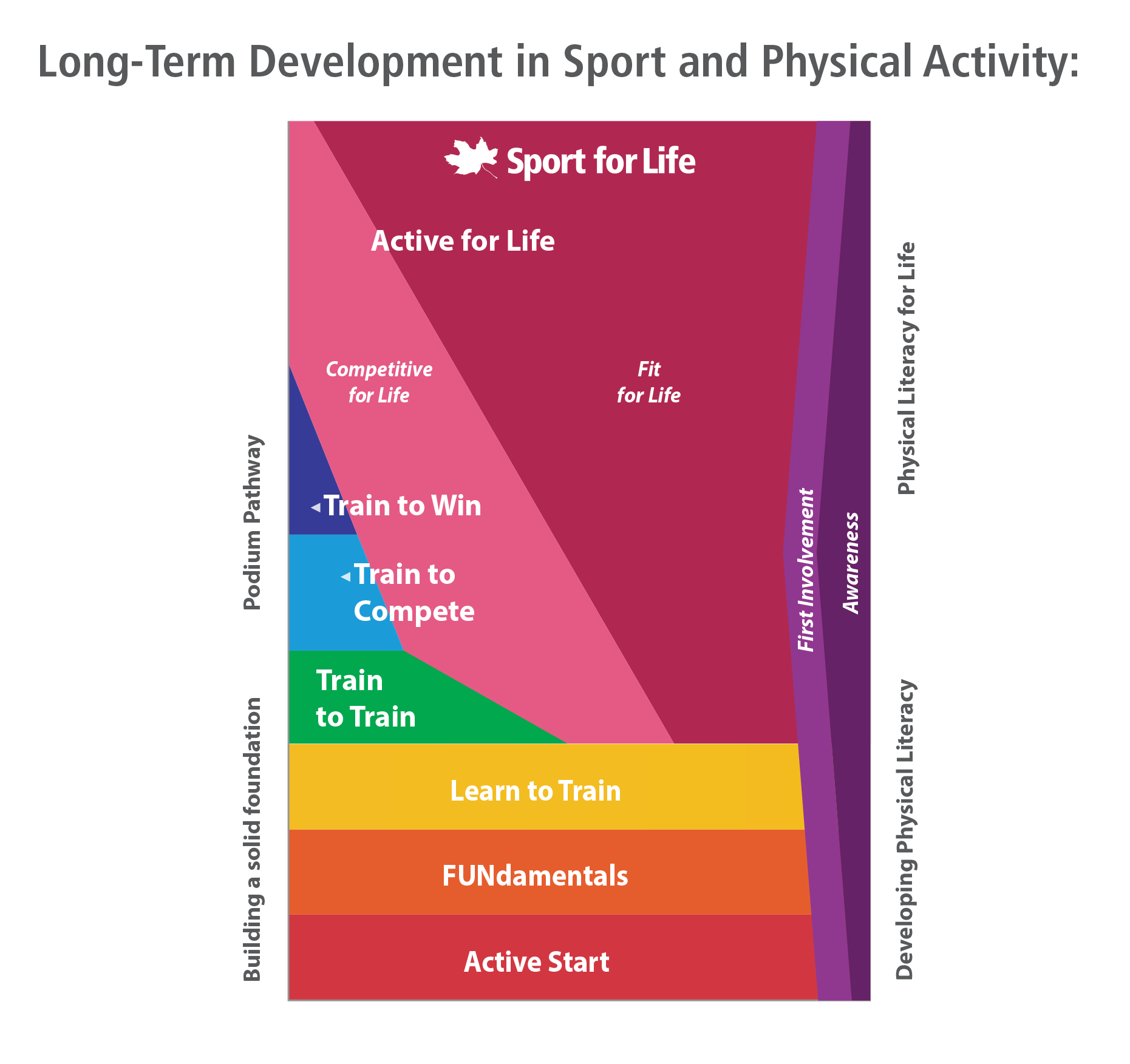
Canada's Long-Term Development in Sport and Physical Activity document ("Sport for Life," which was and is foundational in my coaching philosophies) laid out years ago what the right training windows look like for young athletes.
Here’s a quick breakdown:
🏒 Younger kids (roughly 6–11) — FUNdamentals and Learn to Train stage. Running, jumping, climbing, baseball, lacrosse, bikes, swimming, kickball in the backyard….ya that counts.
🏒 Older kids (roughly 12–16) — Train to Train stage. The biggest window for building strength, speed, and the engine underneath the athlete. Get in the gym. Get strong. Build the body that can handle the demands of the game. Ice time should be intentional, working on technical skills try to stay away from scrimmaging with no purpose in the offseason.
🏒 Late teens and beyond — Training to Compete and Training to Win. But you can only win with the body you built in the years before. If you skip the gym from 12–16 and just keep skating, you do not get to cash in a strong, fast, durable athlete at 17. That ship has sailed.
🎯 A Word to Coaches (Myself Included)
I see it every summer programs front-loading the offseason. 4 ice sessions a week in June and July then August and September roll around and there is almost nothing on the schedule. By the time the real season starts, the players are either burned out, dinged up, or have forgotten many skills they learned in June & July.
If we want players showing up strong and healthy for tryouts and October hockey, we need to flip the script. Less ice in the deep summer. Build strength. Let them play other sports. Then gradually increase the ice touches as we get closer to the season.
What I'd Tell a Parent
👉 Younger kids: Let them play. Soccer, baseball, bike, swimming, go to a playground and go play WITH them. One or two ice touches a week in the summer is plenty. Unstructured play builds coordination that no hockey camp can replicate.
👉 Older kids (13+): Get into the gym. Full stop. Like we have talked about previously. No amount of ice time will make your player faster if they are not strong enough. 2-3 intentional ice sessions per week is great during the summer then load it up leading towards the season.
🏒 Final Thought
Here’s the key thing I want every parent to hear: ice time in the summer isn't the enemy. Kids can absolutely be on the ice during the off-season. The difference is being selective and intentional with when and how that ice fits into their year and into their schedule. If you're ever unsure where your kid falls in this — or how to build a summer that actually sets them up for October — reach out. Whether you attend DS3 sessions or not, I love to talk hockey.
Thanks for reading — see you on the rink. 🏒
David Simoes DS3 Hockey Development
P.S. Huge thank you to Joel Becker for the talk that sparked this one. If you're a coach and you haven't checked out The Coaches Site yet — what are you waiting for?
Studies referenced: Hanke et al. (2021) Clin Orthop Relat Res • Philippon et al. (2013) Am J Sports Med • Larson et al. (2013) Am J Sports Med • Rooks et al. (2020) J Athl Train • Sport for Life framework (sportforlife.ca)